Outsourcing Your Shopee and Lazada Store: What to Hand Over, What to Keep, What It Costs
11 November 2026
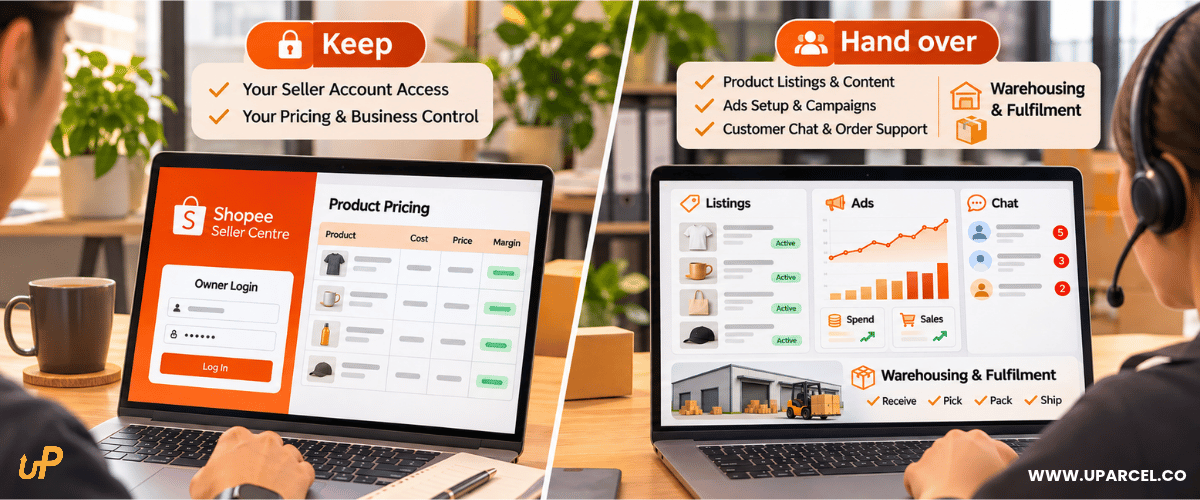
To outsource Shopee store management in Malaysia safely, hand a partner the daily work (listings, ads, chat, campaign set-up, stock updates and fulfilment) and keep ownership: the main seller account, payout bank details, final pricing and budget approval. Pay through a retainer, a commission on sales, or a hybrid, with ad spend billed separately.
It is the week before a mega sale. Vouchers still need setting up, 40 chats are waiting, and someone has to pack yesterday's orders before the late-shipment warning appears in Seller Centre. For many Malaysian brands, that is the moment outsourcing stops being an idea and becomes a decision.
The harder question is what exactly to hand over. This guide sets out a hand-over vs keep split for Shopee and Lazada, how to give access without giving away your account, and how outsourced store management is usually priced. It also shows how uParcel Malaysia, a fulfilment warehouse and marketplace management provider based in Selangor, approaches the handover.
What does it mean to outsource your Shopee and Lazada store?
Outsourcing your store means a partner runs the day-to-day operations of your Shopee and Lazada shops under your brand, while you stay the account owner. The scope can be narrow, such as ads only, or complete, covering listings, campaigns, customer chat, stock and fulfilment from one team.
Most Malaysian sellers land on one of three set-ups:
• Task-based help: a freelancer or agency handles one job, usually ads or listing design.
• Store management: a partner runs listings, ads, campaigns and chat, while you still pack and ship.
• Complete marketplace outsourcing: one partner runs the store and the fulfilment behind it, from listing to doorstep.
Problems usually happen at the hand-off points. When the store team and the packing team are separate, an oversold campaign becomes a debate about whose fault it was.
If you are still deciding whether to keep operations in-house at all, our post on the pros and cons of running it yourself versus hiring a third party covers the wider trade-off.
What should you hand over, and what should you keep?
Hand over work that is repetitive, time-sensitive or skill-heavy: listings, ads execution, chat replies, campaign registration, stock updates and fulfilment. Keep anything tied to ownership, money and brand direction: the main account, payout bank details, pricing floors, ad budget limits and final say on campaign discounts.
|
Area |
Hand over to the partner |
Keep with your business |
Why it matters |
|
Seller account ownership |
Staff-level access with set roles |
Main account login, registered phone and email |
Whoever controls the main account controls the shop |
|
Payouts and finance |
Read-only reports, if needed |
Bank account details and withdrawals |
Protects your marketplace earnings |
|
Pricing decisions |
Price changes within agreed limits |
Price floors, margin targets, final approval |
Stops a campaign from selling below cost |
|
Listings |
Titles, keywords, images, attributes, variations |
Product facts, claims, brand guidelines |
Keeps listings accurate and on-brand |
|
Ads |
Daily bidding, keywords, creative tests |
Monthly budget cap and ROAS target |
You set the money, they make it work |
|
Customer chat |
First replies, order questions, follow-ups |
Refund limits and escalation rules |
Keeps response times up without giving away refunds |
|
Campaigns |
Registration, vouchers, bundles, timelines |
Which campaigns to join, discount depth |
Mega sales are where margins get decided |
|
Stock |
Stock updates, low-stock alerts, reorder suggestions |
Purchase orders and supplier decisions |
You own the cash tied up in stock |
|
Fulfilment |
Storage, pick and pack, dispatch, returns |
Service standards you expect (cut-offs, packaging) |
Shipping speed feeds your shop metrics |
|
Data and reporting |
Weekly and campaign reports |
Access to raw Seller Centre data at all times |
You can switch partners without losing history |

Why chat and fulfilment are worth handing over first
Both are measured by the marketplace, and both slip when a small team gets busy. On Shopee Malaysia, a chat only counts towards your Chat Response Rate if it gets a reply within 12 hours, and auto-replies do not count.
Shopee also uses chat response rate and late shipment rate in its Preferred Seller criteria, with a chat response rate of 85% or higher listed for Preferred Seller status. A partner with set chat hours and a warehouse that ships on time protects both numbers during a peak.
How do you hand over store access without giving away your account?
Give your partner staff-level access through each marketplace's own user tools instead of sharing your owner password. Shopee's Sub-account Platform and TikTok Shop's Seller Center roles let you assign limited permissions, so the partner can work on listings, orders or chat while the main account stays with you.
Here is how the main platforms handle it:
- Shopee: the Sub-account Platform separates a Main Account (with full access) from Member Accounts created for staff or external partners. Shopee's default roles include Administrator, Merchandiser, Fulfilment, Finance, Chat CS and KOL Livestream.
- TikTok Shop: Seller Center offers roles such as Customer Service Agent, Order Fulfillment Specialist and Product Management Specialist. Bank account details, tax information and user management stay visible only to the shop owner's account.
- Lazada: ask the partner exactly how they will access Seller Center without your owner login, and what each person will be able to change.
A Five-Step Handover Process
- Audit the store first: Agree on the starting numbers (sales, ad spend, chat response rate, late shipment rate) so progress can be measured.
- Create staff access, not shared logins: Set up member accounts or roles for each partner user and keep the main account phone number in your name.
- Write down the limits: Price floors, maximum discount per campaign, monthly ad budget and refund rules go into the agreement.
- Move stock and connect fulfilment: If the partner also fulfils, send stock to their warehouse and confirm stock counts before switching orders over.
- Set the reporting rhythm: Weekly reports, plus a pre-campaign plan and a post-campaign review for each mega sale.
What does outsourced store management cost in Malaysia?
Outsourced store management in Malaysia is usually priced as a fixed monthly retainer, a commission on sales, or a hybrid of both. Ad spend, fulfilment, content production and set-up work are often billed separately, so compare total monthly cost per order, not just the headline fee.
Providers rarely publish RM rates for marketplace management, so this guide explains the models rather than quoting figures.
|
Pricing model |
How it works |
Suits |
Watch out for |
|
Retainer |
Fixed monthly fee for an agreed scope |
Brands with steady sales that want predictable costs |
Scope creep: check what counts as "extra" during 11.11 and 12.12 |
|
Commission |
Percentage of sales the partner manages |
Brands that want costs tied to results |
How "sales" is defined (gross, net of returns, before or after vouchers) |
|
Hybrid |
Smaller retainer plus a lower commission |
Growing brands that want shared risk |
Two cost lines that both rise in peak months |
Costs that sit outside the headline fee
Ask for these line by line before you sign:
- Ad spend: paid to Shopee or Lazada directly or passed through the partner, plus any management fee on top.
- Set-up and contract terms: onboarding fees, minimum term and notice period.
- Fulfilment: inbound receiving, storage, pick and pack, packaging and shipping, usually billed per unit or per order. Our planned post on pick-and-pack fees in Malaysia (MY-04) breaks these line items down.
- Marketplace fees: commissions and transaction fees charged by the platform, which stay your cost whoever runs the store.
- SST: management and advertising services can be taxable services under Malaysia's service tax, so ask whether a quote includes SST.
When should you decide, if you want help for 11.11 and 12.12?
Decide before campaign registration and stock planning start, not in the week of the sale. A partner needs time to audit the store, set up access, register campaigns and receive stock. A handover during the peak itself risks late shipments and missed vouchers at the worst moment.
11.11 and 12.12 sit close together, with payday sales around the 25th in between. That leaves little room to fix a rushed handover.
A practical timing check:
- Campaign registration: if your partner will register vouchers and deals, they need access before the registration window closes.
- Stock: if they also fulfil, stock has to be received and counted before orders switch over.
- Ads: campaign ad budgets and keywords should be set before traffic rises, not on the day.
Our upcoming campaign calendar post (MY-01) maps stock, voucher and ad timing around mega sales and payday, and MY-03 covers keeping your late-shipment rate low when 11.11 orders triple.

How does uParcel handle a Shopee and Lazada store handover?
uParcel's CMOS (Complete Marketplace Outsource Solution) puts the whole "hand over" column of the table above with one team. It covers listings, campaigns, marketplace ads, customer service and reporting, plus storage, pick and pack and delivery from a Selangor warehouse, launching alongside that warehouse.
The warehouse opens in November, and CMOS covers store setup and operations on Shopee, Lazada and TikTok Shop. Because the same team manages the listings and ships the orders, there is one point of accountability when a campaign oversells or a parcel runs late.
The same model already runs in Singapore, so brands can add Singapore marketplaces with one partner. For pricing, ask for a quote based on your store's scope and order volume.
See the full scope on the CMOS page, or how the ecommerce warehouse fulfilment service in Malaysia handles storage and dispatch.
Conclusion
Outsourcing your Shopee and Lazada store works best when the split is clear. Hand over the daily work that the marketplace measures, such as listings, chat, campaigns and fulfilment, and keep the main account, payouts, pricing floors and budget approval.
Compare pricing models on total monthly cost, not the headline fee. If you want outsourced store management in place for 11.11 and 12.12, decide before campaign registration and stock planning begin.
Frequently asked questions
01. Will I lose control of my Shopee store if I outsource it?
Not if you keep the main account and give the partner member-level access. Shopee's Sub-account Platform lets you assign roles, and you can remove access at any time. Keep the registered phone number and bank details in your own name.
02. Is there a minimum sales volume before outsourcing makes sense?
There is no platform rule, but the maths changes with volume. If you spend more hours on chat, packing and campaign set-up than on product and growth, outsourcing is worth pricing. Ask providers about minimum fees or minimum order volumes up front.
03. Can I outsource only ads or only customer service?
Yes, many providers offer single-task help. The trade-off is more hand-off points: your ads team may push a product that your packing team cannot ship in time. Complete outsourcing puts those decisions with one team.
04. Who owns my listings and data if I end the contract?
You should. Ask for a clause stating that listings, images, ad accounts and reports created for your store belong to your business. Because the store stays under your main account, your sales history stays with you.
05. Can an overseas brand outsource its Shopee Malaysia store?
Yes, as long as the brand has its own Malaysian entity or importer to bring stock in. uParcel does not handle Malaysian business registration or import customs clearance. Once stock is in Malaysia, CMOS can run the store, storage and fulfilment.
If you're looking for one partner to run your marketplace stores and fulfilment in Malaysia, uParcel's team can walk you through the options. Get in touch to see what fits your business.
 This is a Ecommerce Enabler Posts. Click to read more posts like this.