Switching 3PL Providers in Malaysia Without Disrupting Orders
24 November 2026

11.11 is the stress test for every fulfilment partner. If yours left you with late-shipment warnings in Seller Centre, stock counts that didn't match the warehouse, or buyers posting photos of crushed parcels, you are probably asking whether it is time to move.
Switching 3PL providers in Malaysia is manageable, but the move itself is where sellers get hurt. Stock sits in transit, integrations point to the wrong warehouse, and orders keep arriving the whole time.
This guide covers how to decide whether to switch, when to do it around 12.12, Chinese New Year and Raya, what to check in your current contract, and a step-by-step migration plan that keeps orders moving and your late shipment rate under control.
When Switching Is Worth It and When to Fix the Current Setup
A bad peak does not always mean a bad 3PL. Some problems (late inbound, poor forecasts, missing barcodes) will follow you to any warehouse.
Start by sorting each problem from 11.11 into one of two groups:
|
Problem after 11.11 |
Often fixable with the current 3PL |
Points towards switching |
|
Late shipments |
Stock arrived late or the forecast was too low; cut-off time was never agreed |
Orders missed cut-off on normal days too, not only at peak |
|
Stock mismatches |
SKUs share barcodes or variants were never labelled |
Counts drift every month and the 3PL can't explain the variance |
|
Damaged parcels |
Packaging rules for fragile SKUs were never written down |
Damage continues after you supplied clear packing instructions |
|
Poor communication |
No single contact or weekly report agreed |
Issues raised in writing go unanswered for days |
Fix first when the cause is a missing rule, a data problem or something you control. Agree a written target and give the provider a few weeks to hit it.
Switch when the same failures repeat after the fix, when the 3PL can't show you its own data, or when it can't support your next stage (more SKUs, a new marketplace, faster delivery to Klang Valley buyers). The benefits of an ecommerce logistics partner only show up when the partner is accountable for results you can measure.
Choosing a Switch Window Around 12.12, Chinese New Year and Raya
The best switch window is a quiet stretch with no mega sale or festive stock-up inside it. Timing matters more than speed, because a migration that overlaps a peak puts two weeks of orders at risk.
Work around these dates:
- 12.12: avoid the weeks either side. Campaign stock must be sellable before the sale, and returns keep arriving afterwards.
- Chinese New Year (6 February): stock-up orders and courier cut-offs start weeks before the holiday.
- Ramadan and Hari Raya Aidilfitri: they follow within weeks of Chinese New Year, and shopping peaks during Ramadan. The new 3PL should be stable well before Ramadan begins.
For most marketplace sellers, that leaves two realistic options:
- Late December to early January: after 12.12 orders and returns settle, before Chinese New Year stock-up. It is short, so it suits smaller catalogues.
- After Hari Raya: a longer, calmer window. You stay with the current 3PL through the festive season and use the time to prepare properly.
Count back from the window you choose. Your notice period, the new 3PL's onboarding time and the stock transfer all have to fit before the next peak.
Exit Terms to Check in Your Current 3PL Contract
Your current contract decides how quickly and cleanly you can leave. Read the exit clauses before you tell the provider anything, so your plan is built on what the contract allows.
Look for these four terms:
- Notice period: how much written notice you must give, and whether it runs from the date of your letter or the next billing cycle.
- Minimum term and renewal: whether you are still inside a minimum contract period, and whether the contract has renewed automatically.
- Exit and outbound fees: charges for early termination and for picking, packing and loading your full inventory out of the warehouse.
- Stock release terms: how quickly stock must be released after notice, the condition for release (for example, invoices paid), and how a final joint stock count is handled.
If anything is unclear, ask the provider to confirm it in writing before you serve notice.
A Step-by-Step 3PL Migration Plan
A clean migration runs in a fixed order: data first, then setup, then stock, then systems. Doing these steps out of order is what causes overselling and missed orders during a switch.
Step 1: Export Your Data Before You Serve Notice
Pull every record you need while the relationship is still cooperative.
Export and save:
- SKU master: SKU codes, barcodes, variant names, dimensions, weights and any packing rules.
- Stock on hand: by SKU, by location and by condition (sellable, damaged, quarantined), with expiry or batch details for beauty, supplements and food.
- Open orders: anything received but not yet dispatched, plus any pre-orders or backorders.
- Returns: items received but not yet inspected, items awaiting restock and items set aside for disposal or claims.
Compare the 3PL's stock report with the available stock on your Shopee, Lazada and TikTok Shop stores. Note every gap now, while it is still easy to trace.
Step 2: Set Up the New Warehouse Before Any Stock Moves
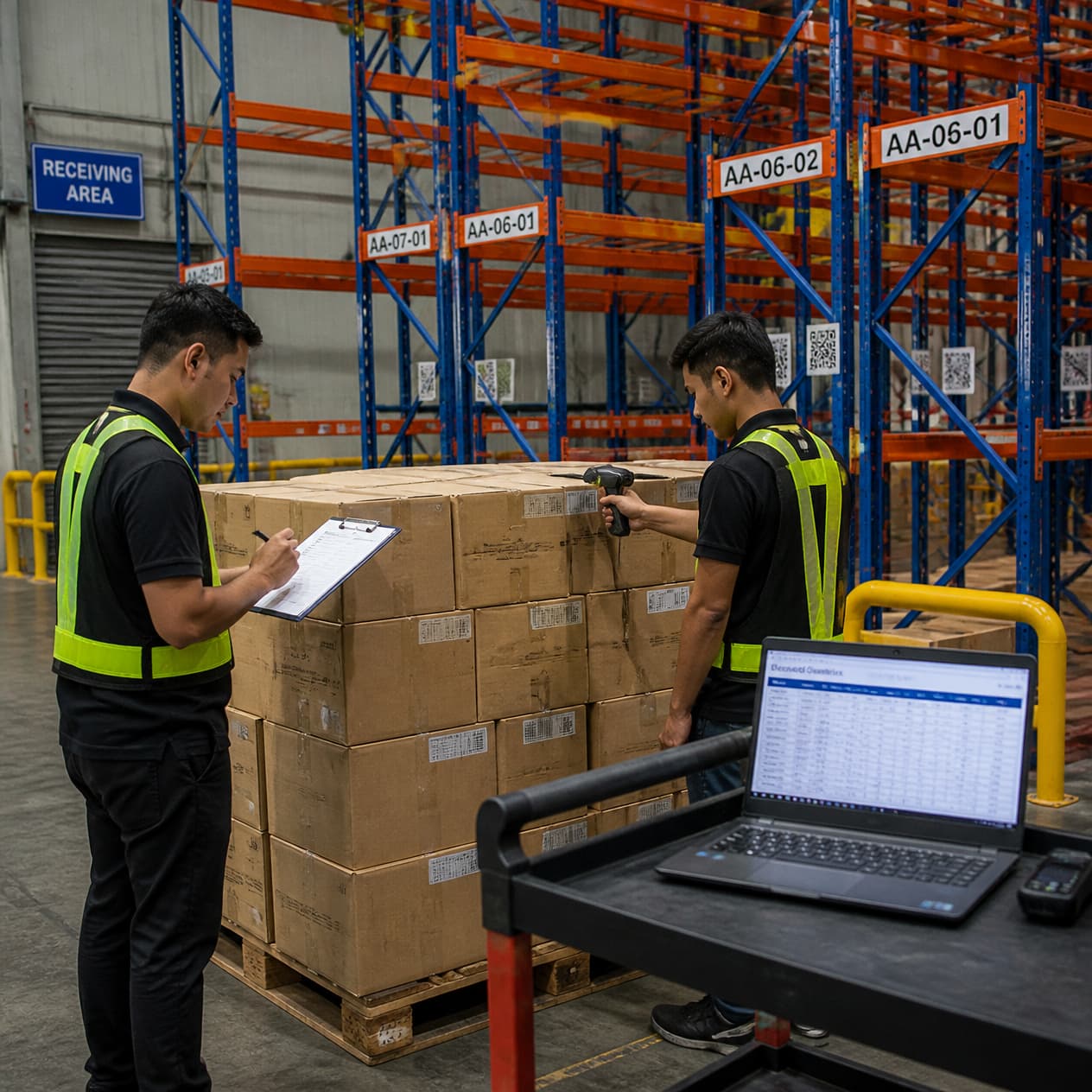
The new 3PL should load your SKU master and confirm every barcode before the first carton arrives.
Agree these points in writing:
- Daily order cut-off for same-day dispatch, matched to each marketplace's shipping deadline.
- Packaging rules per SKU, especially fragile or high-value items.
- How inbound cartons are counted and put away, and how soon stock becomes sellable.
- Daily stock and dispatch reports, and one named contact during the move.
Step 3: Run a Final Stock Count and Reconcile
A joint final count at the old warehouse sets the baseline for everything that follows. Ask for your team, or someone you trust, to attend.
Count by SKU, record damaged and expired items separately, and get the variance report signed by both sides. Then reconcile the old 3PL's system count, the physical count and your marketplace stock, and settle or document any shortfall before stock leaves.
Step 4: Move Stock Between Warehouses in Planned Waves
Moving stock in waves keeps your best sellers available for longer than one big load.
- Wave 1: slow-moving and long-tail SKUs, which can be offline for a few days with little sales impact.
- Wave 2: core SKUs, timed just before the cut-over so they are received and put away at the new warehouse quickly.
- Paperwork: every pallet travels with a packing list by SKU and carton count, so the new 3PL can check it on arrival.
Ask the new 3PL to confirm received quantities against the packing list on the day each wave arrives.
Step 5: Re-Point Marketplace and Store Integrations
Your stores need to send orders to the new warehouse and pull stock levels from it. Test each channel before cut-over day.
- Shopee: update your pickup address in Seller Centre under shipping and address management. Shopee's My Warehouse feature for multiple warehouses is only available to selected sellers, so check whether your shop has it before planning around it.
- Lazada: update your warehouse and pickup address in Seller Center, then check that the first pickup is booked at the new site.
- TikTok Shop: update the warehouse address in Seller Center. TikTok Shop Malaysia also supports multiple warehouses, which can help if old and new sites run side by side for a short time.
- Shopify or your own store: switch the fulfilment app or connector, and turn off the old 3PL's connection so orders are not sent to both.
Update the warehouse mapping in any multi-channel tool too, then follow a test order on each channel through to dispatch.
Step 6: Choose Parallel Running or a Single Cut-Over Day
There are two ways to hand over order flow, and the choice depends on SKU count and volume.
|
Approach |
How it works |
Suits |
Watch for |
|
Parallel running |
Both warehouses ship for a short period, each fulfilling the SKUs it holds |
Larger catalogues, stock moved in waves |
Split orders, two pickup addresses, stock levels tracked in two places |
|
Single cut-over day |
Orders stop going to the old 3PL on a set date and start at the new one |
Smaller catalogues, lower daily volume |
A short gap in shipping while the last stock is received and put away |
Whichever you choose, set a clear cut-off for the old 3PL: the last order time it will ship, in writing.
Step 7: Confirm Pickup and Handover With Marketplace Logistics
Confirm pickup arrangements with each marketplace's logistics partners before go-live.
Shopee advises sellers using SPX Express pickup to update the pickup address in the system and inform their regular driver of the change. Do the same for every courier you use, and confirm the daily pickup time at the new site matches your order cut-off.
Protecting Your Late Shipment Rate During the Cut-Over
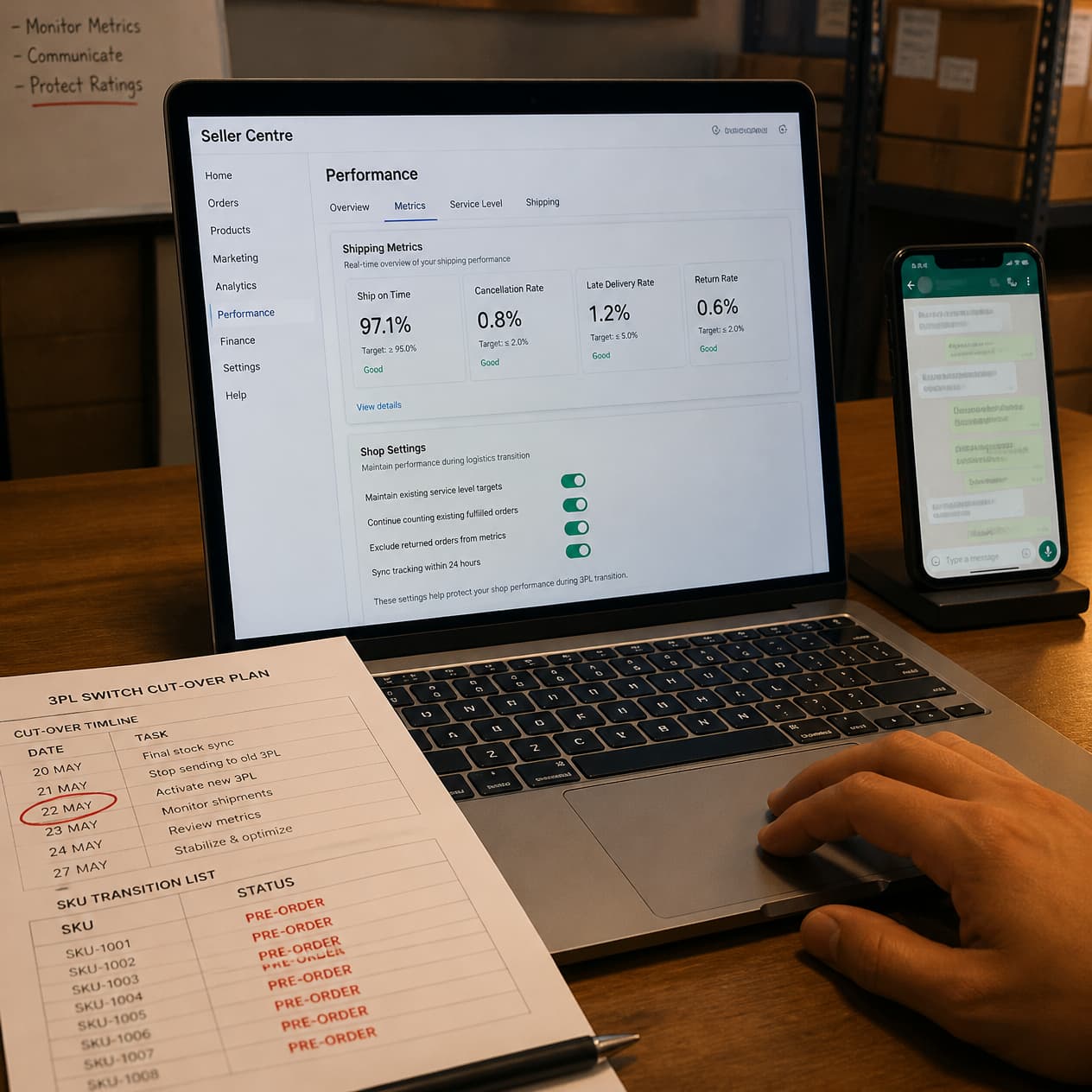
Your late shipment rate counts every order that misses its shipping deadline, whatever caused the delay. During a switch, the aim is to stop taking orders you can't ship on time.
Use these levers, in this order:
- Schedule the cut-over away from campaigns. Don't register for sales, run vouchers or push ads in the days around the move.
- Use pre-order for the few SKUs in transit. On Shopee, the Days to Ship for an individual listing can only be changed when it is set as a pre-order listing, and Shopee expects sellers to keep a low share of pre-order listings. Use it for a handful of SKUs, not the whole store.
- Use vacation or holiday mode only for a true shipping gap. Shopee's Vacation Mode FAQs explain that it can take up to an hour to take effect, should be switched on in advance so pending orders can be cleared, and can't be enabled while the shop has ongoing promotions or campaigns.
- Ship existing orders first. Orders placed before vacation mode takes effect must still ship, and Shopee counts unshipped orders towards your non-fulfilment rate. TikTok Shop's Holiday Mode guide also says existing orders must still be shipped on time.
Lazada has its own holiday mode in Seller Center. Check the current notice requirement there before relying on it, since the rules differ by marketplace.
First-30-Days KPIs to Track With the New 3PL
The first month shows whether the switch fixed the problems that started it. Agree these KPIs and how they are measured before go-live, then review them every week.
|
KPI |
What it measures |
How to check it |
|
Pick accuracy |
Orders shipped with the right SKU, variant and quantity |
Wrong-item complaints and returns, compared with orders shipped |
|
Dispatch time |
Orders handed to the courier before the agreed cut-off |
Daily dispatch report against marketplace shipping deadlines |
|
Damage rate |
Items damaged in storage or packing |
Damage-related returns and buyer photos, tracked by SKU |
|
Inventory accuracy |
System count against physical stock |
Weekly cycle counts of your top SKUs |
Check each week against your Seller Centre data, and raise problems in writing while the onboarding team is still involved.
Switching 3PL Providers in Malaysia With a Clear Plan
A smooth switch is mostly preparation: confirm the provider is the problem, pick a window clear of 12.12, Chinese New Year and Raya, read your exit terms, then move data, stock and integrations in that order. Protect your late shipment rate during the cut-over and track KPIs from day one.
If you are weighing a new partner, uParcel Malaysia, an ecommerce enabler and marketplace management team, is opening a fulfilment warehouse in Selangor, with same-day delivery across the Klang Valley and Selangor. Onboarding would follow the same order as this plan:
- Inbound receiving: your stock is received and checked in at the Selangor warehouse.
- Storage and inventory management: stock is stored and tracked so marketplace stock levels can match what is on the shelf.
- Marketplace order fulfilment: Shopee, Lazada and TikTok Shop orders are picked, packed and dispatched from the same building.
- Returns handling: returned items are received and processed in the same place as your stock.
- Delivery: 3-hour, same-day and next-day delivery in the Klang Valley and Selangor, 1 to 3 working days to the rest of Peninsular Malaysia, and 3 to 7 working days to Sabah and Sarawak.
With storage, fulfilment and delivery under one team, there are fewer handovers to check when switching 3PL providers in Malaysia. To see how it would fit your SKUs and volume, look at uParcel's ecommerce warehouse fulfilment service and talk to the team about timing your move.
 This is a Ecommerce Fulfilment Posts. Click to read more posts like this.